Buy Online
Q: Why do refineries produce different formulations of E10 for summertime?
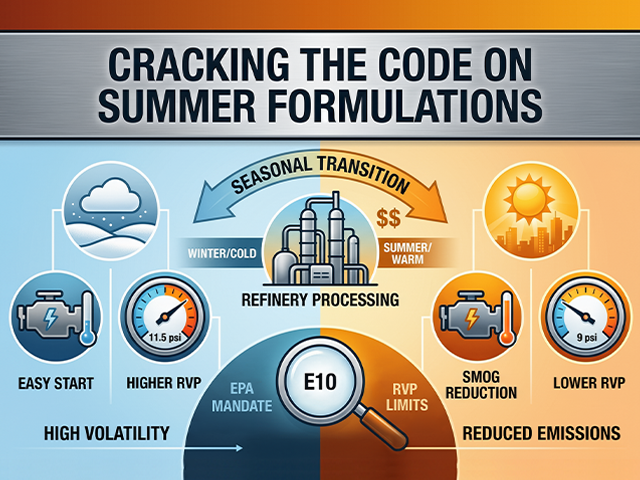
A: Gasoline is more likely to evaporate during the warmer months, producing emissions that contribute to smog. How easily a liquid fuel evaporates is known as “volatility,” which is measured as Reid vapor pressure (RVP). The EPA regulates the RVP of gasoline sold at retail stations to reduce emissions generated by gasoline evaporation. The lower the RVP, the less volatile the gasoline is and the less evaporative the emissions are.
Q: Are the summertime RVP requirements for E10 the same for all cities and states?
A: No. Conventional gasoline, which must have an RVP no higher than 9.0 psi, is the formulation used in most of the United States. The summer blend of reformulated gasoline (RFG), which the Clean Air Act requires in areas with high levels of smog, must have an RVP no higher than 7.4 psi. The EPA estimates that RFG accounts for 25% of U.S. gasoline sales.
A few areas are federally mandated to have gasoline with an RVP no higher than 7.8 psi. Finally, the EPA allows states or regions to set stricter gasoline specifications than the federal requirements. California, for example, requires reformulated gasoline with an RVP of 7.0 psi.
Q: Why aren’t fuels with lower RVP sold all year-round?
A: First, gasoline with a lower volatility is more expensive to produce. This contributes to higher fuel prices in summer. In fact, the EPA relaxed federal enforcement of summer RVP standards for 20 days in May 2026 to help lower fuel prices.
Secondly, fuel with higher volatility helps engines start more easily in cold weather.
Want to Learn More?
For much more information about motor gasoline formulations, including a map of RVP specifications for the continental U.S., check out this article from the U.S. Energy Information Administration.